
What is it?
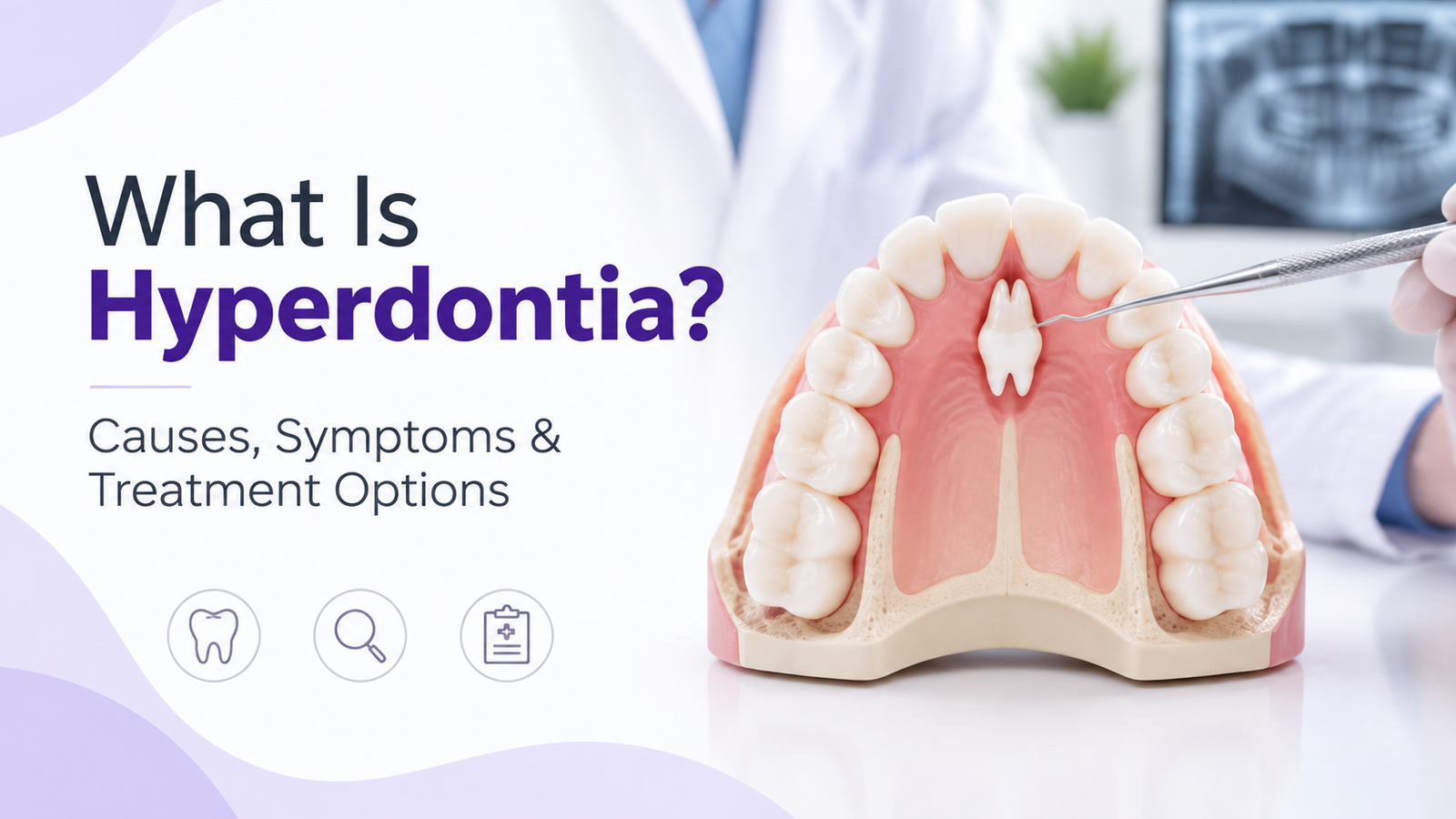
Have you noticed an extra tooth growing in your mouth or been told by a dentist that you have a supernumerary tooth? This condition is called hyperdontia, and while it might sound alarming, it is more common than you think, affecting between 1% and 4% of the population. Hyperdontia is the dental term for having one or more extra teeth beyond the normal count as normally there are 20 primary (baby) teeth in children and 32 permanent teeth in adults. These extra teeth are called supernumerary teeth, and they can appear anywhere in the dental arch, in any shape, and at any age. In this guide, the team at Gentle Dental Family Care in Kew Gardens, Queens NY explains exactly what hyperdontia is, what causes it, what symptoms to watch for, and what your treatment options are.
Understanding Hyperdontia and Its Severity
Hyperdontia is more than just an extra tooth – it can significantly impact your bite alignment, oral hygiene, and self-confidence. In cases of extreme hyperdontia, where multiple hyperdontia teeth develop, patients may face discomfort, crowding, and difficulty chewing. If you’re wondering, “is hyperdontia dangerous?”, the answer depends on the number, location, and growth direction of the supernumerary teeth. Left untreated, it may cause damage to surrounding teeth or even lead to cysts.
Symptoms
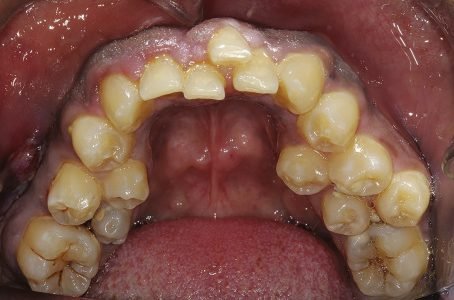
The main symptom of hyperdontia that you will notice is extra teeth that grow directly behind or close to your usual primary or permanent teeth. These teeth usually appear in adults. They’re twice as common in men than they are in women.
Extra teeth are categorized based on their shape or location in the mouth.
Shapes of extra teeth include:
- Supplemental- The tooth is shaped similarly to the type of tooth that it grows near.
- Tuberculate- The tooth has a tube or barrel-like shape.
- Compound Odontoma–The tooth is made up of several small, tooth-like growths near each other.
- Complex Odontoma- Rather than a single tooth, an area of tooth-like tissue grows in a disordered group.
- Conical, or peg-shaped- The tooth is wide at the base and narrows out near the top, making it look sharp.
Types of Hyperdontia Supernumerary Teeth
There are different types of hyperdontia supernumerary teeth, including supplemental, conical, and tuberculate forms. These extra teeth can appear anywhere in the dental arch but are most commonly found near the permanent incisors. Each type presents unique challenges for diagnosis and removal. Recognizing the early signs of hyperdontia helps dental professionals develop a proactive treatment plan tailored to each patient’s needs.
What Are Supernumerary Teeth?”
Supernumerary teeth is the medical term for the extra teeth that develop in cases of hyperdontia. The word “supernumerary” simply means “beyond the normal number.” So hyperdontia and supernumerary teeth refer to the same condition – just using different terminology. Most adults have 32 permanent teeth. Any tooth that develops beyond this number is classified as a supernumerary tooth. The most common type of supernumerary tooth is called a mesiodens – an extra tooth that grows between the two upper front teeth. Other common types include:
• Paramolar – an extra tooth near the back molars
• Distomolar – an extra fourth molar growing behind the wisdom teeth
• Peridens – a supernumerary tooth growing outside the normal dental arch
Supernumerary teeth can be fully erupted (visible in the mouth), partially erupted, or completely impacted (hidden beneath the gum line and only detectable on an X-ray). At Gentle Dental Family Care in Queens, we use digital X-rays at routine checkups to detect supernumerary teeth early – before they cause problems.
Teeth Behind Teeth – Extra Rows and Double Rows Explained
One of the most common and noticeable signs of hyperdontia is teeth growing behind existing teeth, creating what appears to be a double row of teeth. This is especially common in children, where extra primary or permanent teeth grow directly behind the front teeth – a phenomenon sometimes called “shark teeth” because it resembles the multiple rows of teeth found in sharks. In adults, extra teeth growing behind or alongside permanent teeth can cause:
• Crowding and misalignment of surrounding teeth
• Difficulty chewing or biting properly
• Increased difficulty cleaning between teeth, leading to decay risk
• Discomfort or pain as the extra tooth pushes against existing teeth
If you or your child has what appears to be two rows of teeth, extra teeth growing in the upper or lower jaw, or a tooth growing behind existing teeth, this should be evaluated by a dentist as soon as possible. In many cases, early extraction of the supernumerary tooth allows the surrounding permanent teeth to shift naturally into their correct position. At Gentle Dental Family Care in Kew Gardens, Queens, we treat patients with hyperdontia of all ages – from children with “shark teeth” to adults with impacted supernumerary teeth discovered on X-ray.
Where Do Extra Teeth Grow? Common Locations
Extra supernumerary teeth can appear anywhere in the mouth, but certain locations are more common than others:
• Between the upper front teeth (mesiodens) – the most common location. Often impacted beneath the gum and only visible on X-ray.
• Behind the front teeth – a visible extra tooth growing directly behind existing front teeth, causing crowding or misalignment.
• On the roof of the mouth (palate) – extra teeth can grow upward into the palate, sometimes causing discomfort or interfering with the bite.
• In the back of the mouth – extra molars or premolars growing behind or alongside existing back teeth.
• In the lower jaw – while less common than upper jaw hyperdontia, extra teeth can appear in the lower front or back sections.
• Growing in the gums – partially or fully impacted extra teeth that have not fully broken through the gum surface.
Regardless of location, any extra tooth that causes crowding, pain, or alignment issues should be evaluated. Some supernumerary teeth that remain fully impacted and cause no problems may simply be monitored with regular X-rays rather than removed immediately.
Causes
Their is no clear cause of hyperdontia.There have been studies that suggest that there may be a genetic factor in hyperdontia consisting of an autosomal dominant trait with low penetrance (only sometimes producing supernumerary teeth in a carrier of the mutated gene). Other possible causes include environmental factors and over activity of the dental lamina during tooth development. The dental lamina is a zone of cells that initiates the formation of the tooth germ, which forms the tooth.
Treatment
Treatment for hyperdontia can vary from person to person. The most common approach is an extraction. Since hyperdontia commonly occurs around the permanent anterior incisors of the maxillary arch (next to your top front teeth), it can be an orthodontic and a cosmetic concern. It is always best to talk with your dental health professional at Gentle Dental Family Care in Kew Gardens about the proper treatment for you.
Approach to Hyperdontia Removal and Management
Not every case of hyperdontia requires removal. However, if the extra tooth is causing discomfort, disrupting the bite, or impacting adjacent teeth, extraction may be recommended. Dental professionals usually assess each case based on the number, location, and shape of the supernumerary teeth. If you or your child is dealing with hyperdontia, consulting with a dentist is the best step to explore options for care, including the possibility of hyperdontia removal when necessary.
Your Dental Health
When it comes to hyperdontia, early diagnosis makes all the difference. Supernumerary teeth that are caught early – before they cause crowding, pain, or alignment problems – are far easier and less expensive to treat. At Gentle Dental Family Care in Kew Gardens, Queens NY, Dr. Rafael Roman Boruchov, DDS assesses each case individually. Not every extra tooth requires immediate removal – some cases of hyperdontia can simply be monitored with periodic X-rays. But when removal is recommended, our team provides gentle, expert oral surgery and extraction services in a calm, patient-first environment. If you or your child has an extra tooth, teeth growing behind teeth, or you have been told you have a supernumerary tooth, contact our Queens dental team today. To set up your appointment give us a call at (718) 849-9797. We also welcome walk-ins, to accommodate patients with a busy schedule. We hope to see you soon!
Frequently Asked Questions
What is hyperdontia?
Hyperdontia is a dental condition where one or more extra teeth grow beyond the normal number – 20 baby teeth in children or 32 permanent teeth in adults. These extra teeth are called supernumerary teeth and can appear anywhere in the mouth.
What are supernumerary teeth?
Supernumerary teeth is the medical term for extra teeth caused by hyperdontia. They can be visible in the mouth, partially erupted, or fully impacted beneath the gum and only detectable on an X-ray. The most common type is a mesiodens – an extra tooth between the upper front teeth.
Is hyperdontia dangerous?
Hyperdontia is not always dangerous. Mild cases with a single impacted tooth that causes no symptoms may simply be monitored. However, if left untreated, extra teeth can cause crowding, misalignment, difficulty chewing, and increased risk of cavities or gum disease. A dentist will assess the severity of each case.
Is hyperdontia rare?
Hyperdontia affects between 1% and 4% of the population, making it relatively uncommon but not extremely rare. It is approximately twice as common in males as in females, and most cases involve a single extra tooth near the upper front teeth.
What causes hyperdontia?
The exact cause of hyperdontia is not fully understood. It is likely genetic, with studies suggesting an autosomal dominant inheritance pattern. It is also associated with certain syndromes including Gardner syndrome, cleidocranial dysplasia, and cleft palate. Environmental factors during tooth development may also play a role.
Why do I have teeth behind my teeth?
Teeth growing behind existing teeth is one of the most visible signs of hyperdontia. Extra teeth commonly grow directly behind the upper or lower front teeth, creating a double row appearance. This is especially common in children and is sometimes called shark teeth. Early evaluation by a dentist is recommended.
Does hyperdontia require surgery?
Not always. If the extra tooth is causing no symptoms, crowding, or alignment issues, it may simply be monitored. If it is impacted, causing pain, disrupting adjacent teeth, or creating hygiene problems, extraction is usually recommended. In some cases this is a straightforward dental extraction; in others a minor oral surgery may be required.
Can hyperdontia grow back after removal?
In rare cases, a new supernumerary tooth may develop after removal of the original extra tooth. Regular follow-up X-rays are recommended after treatment to monitor for any recurrence, particularly in children whose dental development is still ongoing.
How is hyperdontia diagnosed?
Hyperdontia is diagnosed through dental examination and X-rays. If the extra tooth has already erupted, it is visible in the mouth. Impacted supernumerary teeth that have not broken through the gum can only be detected on dental X-rays or CT scans. This is why regular dental checkups with X-rays are important.
How is hyperdontia treated in Queens NY?
At Gentle Dental Family Care in Kew Gardens, Queens, Dr. Roman assesses each case with a clinical examination and X-rays. Treatment ranges from regular monitoring to extraction or oral surgery, depending on the number, location, and impact of the extra teeth. Call (718) 849-9797 to book an evaluation
