
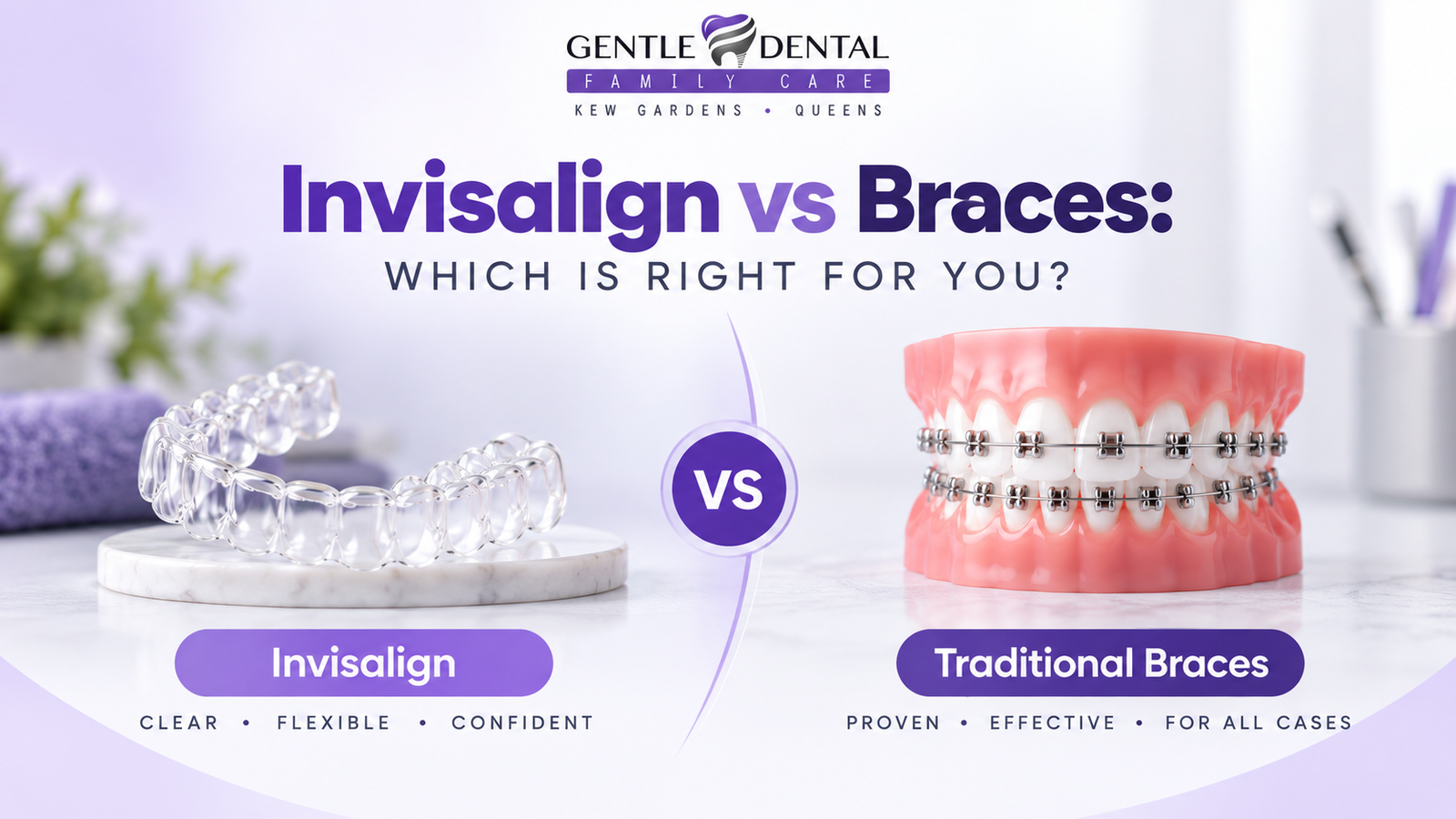
Trying to decide between Invisalign and braces? You are not alone – it is the single most common orthodontic question we hear from patients across Queens. Both treatments can give you a straighter, healthier smile. But they work differently, cost differently, feel differently, and suit different lifestyles.
At Gentle Dental Family Care in Kew Gardens, Queens, Dr. Roman has helped hundreds of patients make this exact decision. In this guide, he breaks it all down – honestly – so you can choose the right option for your specific situation.
The quick answer: Invisalign is best for adults and most teens with mild to moderate alignment issues who want a discreet, flexible treatment. Braces are better for complex cases or patients who need a fixed appliance. When in doubt, a free consultation with Dr. Roman will give you a clear answer in 30 minutes.
What Is the Difference Between Invisalign and Braces?
Invisalign uses a series of custom-made clear plastic aligners that fit snugly over your teeth. You wear each set for 1–2 weeks before switching to the next, gradually moving your teeth into their correct position. Aligners are removed for eating, drinking, and brushing.
Traditional braces use metal brackets bonded to each tooth, connected by a wire that applies continuous pressure. They are fixed – you cannot remove them during treatment. Ceramic (tooth-coloured) and lingual (behind-the-teeth) braces are also available.
Both methods work by applying controlled force to shift teeth. The key differences come down to visibility, comfort, cost, lifestyle impact, and which cases each handles best.
Invisalign vs Braces – Complete Comparison Table
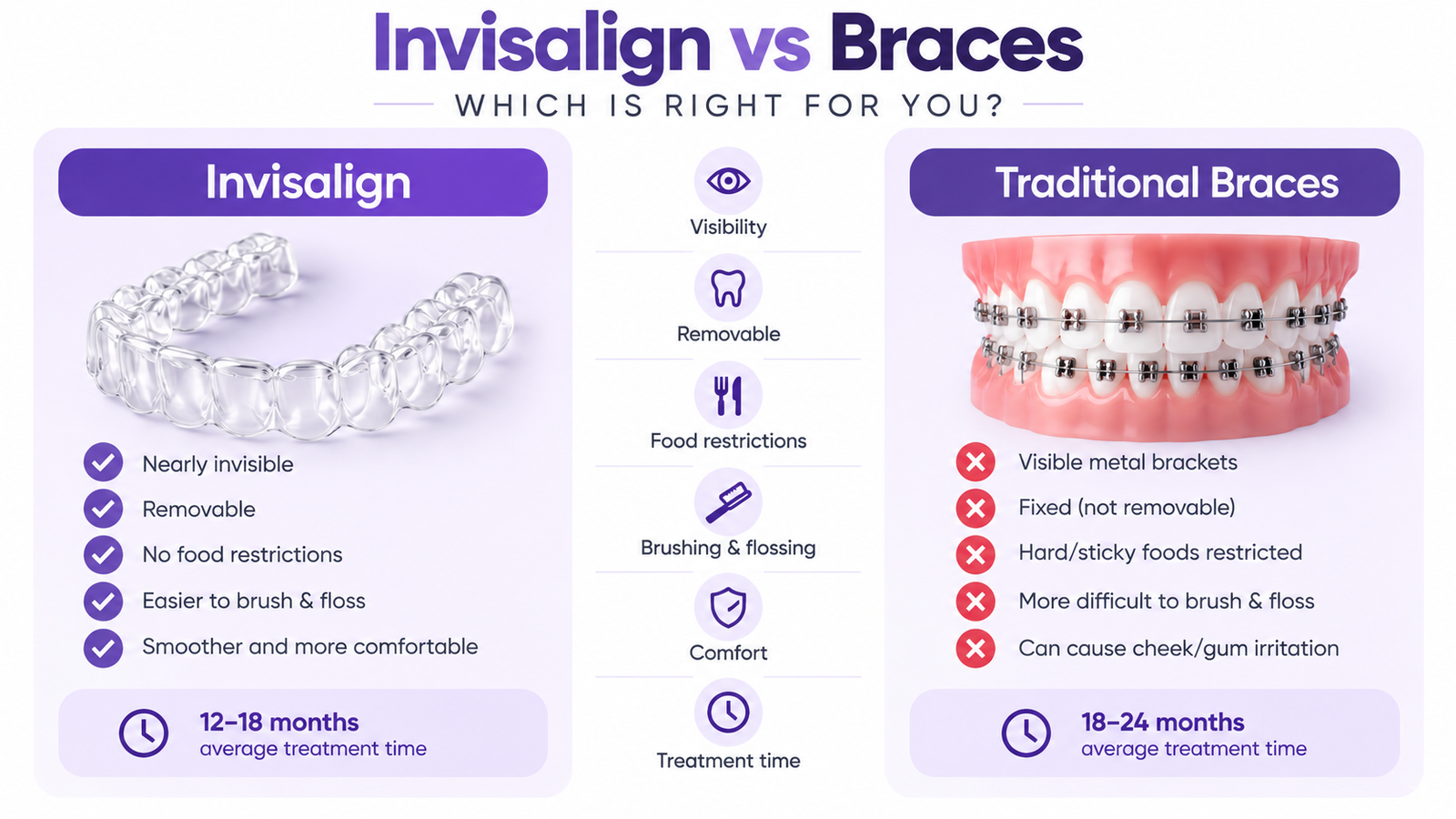
| Factor | Invisalign | Traditional Braces |
| Visibility | Nearly invisible | Visible metal brackets |
| Removable | Yes | No – fixed |
| Food restrictions | None | Hard/sticky foods restricted |
| Brushing & flossing | Easy – remove aligners | More difficult around brackets |
| Comfort | Smooth plastic, minimal irritation | Can cause cheek/gum irritation |
| Treatment time | 12–18 months average | 18–24 months average |
| Office visits | Every 6–8 weeks | Every 4–6 weeks |
| Works best for | Mild to moderate cases | Mild to severe/complex cases |
| Compliance needed | High – 20–22 hrs/day | Low – fixed in place |
| Insurance coverage | Same as braces (most plans) | Standard coverage |
Invisalign – Pros and Cons
Pros of Invisalign
- Nearly Invisible
This is the biggest reason Queens adults choose Invisalign. The clear aligners are virtually undetectable in conversation, at work, and in photos. You can undergo orthodontic treatment without anyone knowing. - No Food Restrictions
Remove your aligners to eat anything you want – bagels, apples, popcorn, whatever you like. No dietary changes required. - Easier Oral Hygiene
Brushing and flossing with Invisalign is exactly the same as without. Remove, clean your teeth, clean the aligners, replace. Patients consistently report better gum health during Invisalign treatment compared to braces. - More Comfortable
Smooth plastic aligners with no wires or metal edges. Minimal irritation to cheeks and gums. Most patients feel mild pressure when switching to a new aligner – not pain. - Fewer Office Visits
Progress checks every 6–8 weeks versus every 4–6 weeks with braces. Less time away from work or school. - See Your Results Before You Start
Invisalign’s 3D software generates a digital preview of your tooth movement from start to finish. You see your projected smile before wearing a single aligner.
Cons of Invisalign
- Requires Discipline
Aligners must be worn 20–22 hours per day to work as intended. Patients who frequently forget to replace them after meals will see slower or incomplete results. This is the number one reason Invisalign underperforms – not the technology, but the compliance. - Not Ideal for Very Complex Cases
Severe rotations, large bite discrepancies, or significant skeletal issues may require traditional braces or a combination approach. Dr. Roman will advise you honestly at your consultation. - Must Remove to Eat and Drink
While food restriction-free, you must remove aligners before every meal and brush before replacing them. This can feel inconvenient in social situations or when eating out frequently. - Attachments May Be Needed
Some patients need small tooth-coloured attachments bonded to specific teeth to help aligners grip and move them precisely. These are discreet but visible up close.
Traditional Braces – Pros and Cons
Pros of Braces
- Works for All Case Types
Braces can treat the full range of orthodontic issues – from simple crowding to severe bite problems, jaw discrepancies, and complex rotations. If your case is complicated, braces remain the most reliable option. - No Compliance Required
Fixed to your teeth – braces work 24/7 without any action from you. Ideal for younger teens who may not consistently wear removable aligners. - Potentially Faster for Complex Cases
Braces apply continuous, uninterrupted force. For difficult cases involving significant movement, this can mean faster completion than Invisalign. - Multiple Options
Metal braces are the most affordable. Ceramic (tooth-coloured) braces are more discreet. Lingual braces are placed behind the teeth and nearly invisible. Your options are wider than most people realise.
Cons of Braces
- Visibly Noticeable
Traditional metal brackets are immediately noticeable. For adults in professional settings or self-conscious teens, 18–24 months in visible metal is a significant concern. - Food Restrictions
Hard foods, sticky foods, and chewy foods can damage brackets or wires. Broken hardware means unplanned appointments and potentially extended treatment time. - Harder to Keep Clean
Plaque builds up around brackets and wires more easily. Without meticulous oral hygiene, patients risk white spot lesions, cavities, and gum disease during treatment. - More Regular Appointments
Monthly adjustment visits to tighten wires and check progress – more time off work or school over the course of treatment. - Soreness After Adjustments
Most patients experience 2–3 days of soreness after each monthly adjustment. Wires and brackets can also cause cheek irritation, especially in the first few weeks.
Is Invisalign Faster Than Braces?
One of the most common questions patients ask is which treatment is faster.
For mild to moderate cases, Invisalign and braces have comparable treatment times – typically 12–18 months for Invisalign vs 18–24 months for braces on average.
For complex cases, braces can sometimes close the gap faster because they apply more continuous, powerful force without relying on patient compliance.
The most important factor with Invisalign is wear time. Patients who wear aligners the required 20–22 hours per day consistently finish on or ahead of schedule. Patients who frequently remove them for long periods will extend their treatment significantly.
Does insurance cover Invisalign?
Most dental insurance plans that include orthodontic benefits apply the same coverage to Invisalign as to braces. At Gentle Dental Family Care, we verify your insurance coverage before you begin treatment.
We also offer flexible payment plans and financing options to make treatment accessible for Queens families.
Not sure what your treatment will cost?
Book a free Invisalign consultation with Dr. Roman. We will assess your case, discuss all options, and give you an exact quote – no pressure, no obligation.
Same-day appointments available. Call (718) 849-9797.
Invisalign vs Braces for Adults
Invisalign is overwhelmingly the preferred choice for adults in Queens, and for good reason:
- Adults in professional settings value the discretion of clear aligners
- Lifestyle flexibility – eating without restrictions, cleaning normally – fits busy adult schedules
- Fewer office visits mean less time off work
- The compliance requirement is more reliably met by motivated adults than by younger teens
That said, adults with complex bite issues or those who want the most powerful correction available may still be better served by braces – particularly ceramic or lingual options that maintain a more discreet appearance.
Invisalign vs Braces – Which Is Right for You?
Choose Invisalign if you:
- Are an adult or older teen who values a discreet treatment
- Have mild to moderate crowding, spacing, or bite issues
- Want to eat without any restrictions
- Can commit to wearing aligners 20–22 hours daily
- Prefer fewer appointments and more lifestyle flexibility
Choose Braces if you:
- Have complex orthodontic issues or severe bite problems
- Are a younger teen who may struggle with aligner compliance
- Want a fixed appliance that works without daily discipline
- Are looking for the most affordable option
- Have a preference for ceramic or lingual options for discretion
Frequently Asked Questions – Invisalign vs Braces
Q: Is Invisalign better than braces?
For most adults with mild to moderate alignment issues, Invisalign delivers comparable results to braces with significantly more convenience and discretion. For complex cases, braces may be more effective. The best option depends on your specific teeth.
Q: Is Invisalign faster than braces?
For similar cases, treatment times are comparable – 12–18 months for Invisalign vs 18–24 for braces. Speed depends heavily on case complexity and, for Invisalign, on how consistently you wear your aligners.
Q: Does Invisalign hurt more than braces?
Most patients find Invisalign more comfortable overall. There is mild pressure when switching to a new aligner every 1–2 weeks. Braces cause more soreness after each monthly adjustment and can cause wire/bracket irritation to cheeks.
Q: Are braces cheaper than Invisalign in Queens?
Metal braces are generally the most affordable option, starting around $3,000 for simple cases. Invisalign starts in a similar range but can cost more for complex cases. Insurance often covers both equally. We offer financing for both.
Q: Can I get Invisalign instead of braces?
In most cases, yes. Invisalign now treats the majority of alignment issues that previously required braces. The exception is very complex cases with severe skeletal problems. A consultation with Dr. Roman will confirm whether you are a candidate.
Q: Does Invisalign work as well as braces?
For mild to moderate cases, clinical studies and patient outcomes consistently show comparable results. For complex cases, braces may produce a more precise final result. Invisalign technology has advanced significantly in recent years.
Q: What happens if I lose an Invisalign aligner?
Contact our office immediately. Depending on where you are in treatment, we can order a replacement or advise you to move to the next set. We recommend keeping your previous aligner set until you are fully comfortable with the current one.
Q: Is there an Invisalign dentist near me in Queens?
Yes – Gentle Dental Family Care is located at 118-60 Metropolitan Ave, Suite #1B, Kew Gardens, Queens NY 11415. We serve patients from Forest Hills, Richmond Hill, Jamaica, Briarwood, and all of Queens. Book a free consultation today.
Q: Can I switch from braces to Invisalign?
In some cases yes, depending on how far along your treatment is and the nature of your case. Book a consultation and Dr. Roman can assess whether switching makes sense for your situation.
Q: Does Invisalign work for overbites?
Yes – Invisalign treats mild to moderate overbites effectively. For severe skeletal overbites, braces or a combination approach may produce better results. Dr. Roman will advise you at your Queens consultation.
Ready to Decide? Start With a Free Consultation in Queens
Whether you choose Invisalign or braces, Gentle Dental Family Care in Kew Gardens, Queens has the expertise and technology to deliver outstanding results.
